
Building the Lodge Within
A Pilfered Piece of Architecture

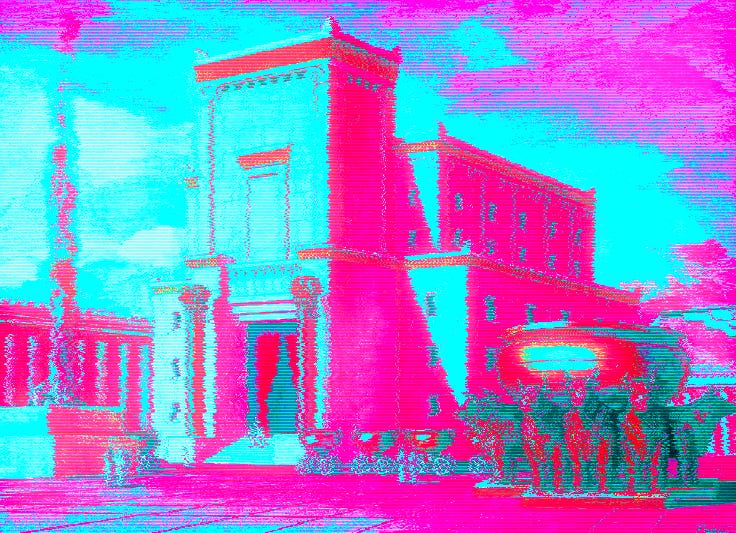
This post is a Divine Heresy.
I originally wrote it as a Piece of Architecture while a member of The Eastern Order of International Co-Freemasonry, so it’s at least 15 years old. I’m honestly not sure. It has been up and down on various blogs over time. I have mixed feelings about discussing it at all. I joined this Order for two reasons:
· The admission of both men and women as full and equal members was something important to me and I wanted to support the movement in turn. This meant forever being branded a “clandestine” Brother by the Grand Lodge, which suited me just fine.
· Its emphatic esoteric approach to Freemasonry, including esoteric instruction, which we were given to understand is not common practice in so-called “masculine” Lodges, which generally leave the pursuit of such knowledge up to the individual Freemason.
I will never regret doing so.
To look back on it now is something else, as I realize now how foundational this philosophy has been in everything I have done ever since. It is also interesting because I now realize that what those two facts together is saying—without using any words at all—is this:
Recognize the Goddess.
At this tense time in human history, as we all negotiate the imperatives of self and other, I think its message is useful; and so, without regard for any other consequence, I publish it as the spirit moves me. One last note—a confession: It was inspired by the mention of Constructivism in an essay I had found on the website of some Golden Dawn offshoot I was looking into—I think might have been Ordo Stella Matutina.
Freemasonry is a multifaceted activity full of symbolism. For every object in Lodge and each line of the ritual, there are countless layers of meaning to be found. Once found, this meaning is carried further as we apply it in our lives. The richness of Freemasonry’s symbolism is undoubtedly one of the keys to its long-standing success in the world; it also makes Freemasonry a highly personal and individual pursuit in some respects. Yet the collective aspect of Freemasonry is just as instrumental to its survival as the veritable infinity of its symbolic bounty. It is one thing to read the ritual book, to take in tomes offering up interpretations for Freemasonry’s component parts and to study the history of this grand tradition; it is quite another to stand with one’s fellows in Lodge and to take part in the building of the Temple. Freemasonry as an intellectual pursuit is entirely different from Freemasonry as an active process. Freemasonry is nothing without the Masons that give it vitality and purpose.
When contemplating the symbolism of Freemasonry, it is important that we ask ourselves where the meaning of its symbols comes from. Many of us came to Freemasonry with questions in our minds and the hopes that answers would be given in due time. There is nothing wrong with this; on the contrary, we have all found that we cannot do this alone. Mutual help is the cornerstone of our work and without the insights offered to us by our fellows, we would be lost. Many were the tokens of wisdom offered to me by other Masons both past and present in my Masonic career; but such found wisdom does not alone constitute sufficient wages for our work. For one thing, as time wears on, many of the words and symbols lose their previous relevance. Language, like a living organism, is constantly evolving, relegating some terms to obscurity and rendering their power as storehouses of symbolism less potent. Like a pun needing extensive explanation, while we can come to integrate them into our lexicon of philosophical learning, their impact is dampened somewhat by the process. Secondly, no wisdom or meaning that is given to us by another can be quite as compelling as that meaning which arises from within. Indeed, the greatest of riches that Masonic symbolism has to offer us may stem from the interpretations that well up from within us. Far from being passive listeners to the tale that Freemasonry has to tell us, we are more like the characters in the story, creating it and re-creating it with each passing moment.
In the interest of exploring Freemasonry as an ongoing narrative, and with an eye toward keeping it fresh and current, it is worthwhile to continually seek new metaphors--to link Freemasonry with modern thought as well as that timeless wisdom which has no true outer form. One such relevant connection to Freemasonry is the theory of knowledge and learning known as constructivism. Championed most notably by Jean Piaget and applied by Maria Montessori, constructivism is readily applicable to the enterprise of Freemasonry. Like any symbol drawn from the ritual, the concept behind it is as simple as it is profound. It is empowering to the individual and the group alike. Even its name, “constructivism,” seems to speak directly to Freemasonry and its central metaphor of building.
In a nutshell, constructivism posits that the process of learning involves the building of internal models of the world around us. Contrasted with the idea that we are each like a blank slate, passively “written upon” as infants by the adults who teach us, constructivism is the view that learning is very much an active process. According to constructivism, when we learn, each piece of knowledge is a building block that we grasp with our own figurative hands, taking ownership of it and finding its place for ourselves in the body of knowledge that we are continually building. Just as with building blocks (or perhaps LEGO?), what one child does with a given brick may not be what another child does with it. As with any creative endeavor, our body of knowledge carries our own signature, our own personal touch. Certain aspects may be universal—every castle needs walls, floors and ceilings—but the specific details may differ. Our world outlook is based on our body of assimilated knowledge, and as we know, everyone’s outlook is unique. While this theory strongly emphasizes the individual, it is also inherently social; interaction between individuals is essential to the learning process, as no person is a vacuum.
One application of constructivism is constructionism, a specific learning approach that is based on constructivist theory (let the author offer his apologies for the similarity of the terms and the confusion that may result). Constructionism is based on the idea that constructivism works best in the construction of some specific product by a group. This product can be anything, whether it be a float for a parade, a play, or even something more abstract like a computer program. In the case of Freemasonry, the “product” can be looked upon as the enactment of the ritual. In order for it to be done properly, each of us must work together. We are most responsible for learning our own specific part, but the end result will be better to the extent that we also learn the parts of others—the more accurate our internal model of the ritual as a whole, the better we can integrate our own part into the whole. In short, Freemasonry is a constructionist learning environment in that we each learn together as we “construct” the ritual.
Love how connecting Piaget's constructivism to Masonic ritual reframes learning as active creation rather than passive reception. The idea that each Mason builds their own internal model of the Lodge while collectively constructing the ritual is elegant. I've expereinced similar dynamics in other collaborative practices where individual interpretation feeds back into group knowledge.